 Sankashti Chaturthi Mandal
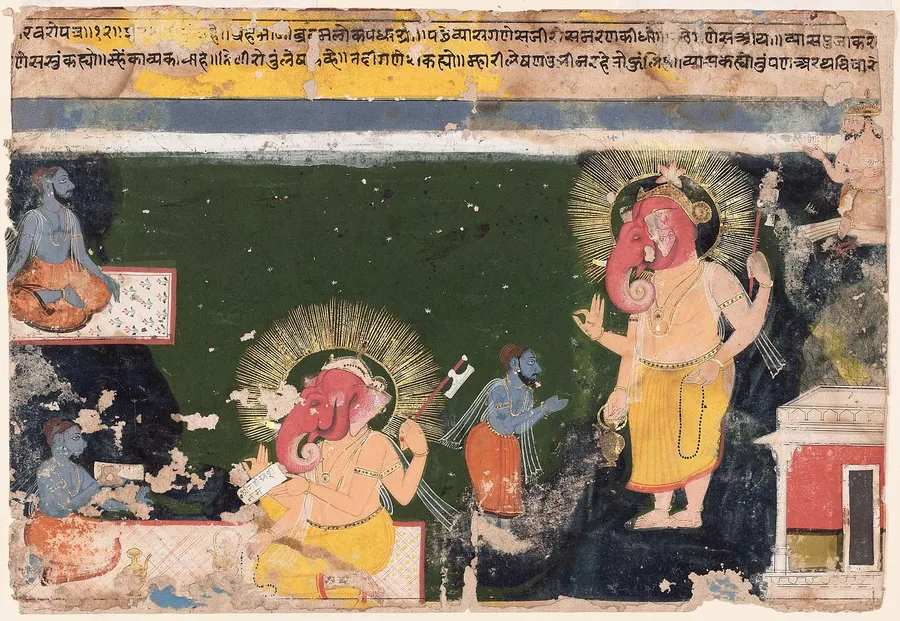 Painting: 17th-c. Mewar manuscript, Museum of Fine Arts, Boston / Wikimedia Commons (Public domain)
Shree Ganesh is instantly recognizable by a single broken tusk, an asymmetry that could easily be read as damage or loss. In devotional understanding, it is read instead as one of his deepest teachings.
Wholeness Beyond Symmetry
Two tusks, matched and unbroken, would suggest a world of neat pairs: right and wrong, gain and loss, pleasure and pain, held apart from one another. Shree Ganesh's single remaining tusk points past this divided way of seeing, toward a unity that does not depend on everything being intact or matched to be whole.
What Was Given, Not Merely Lost
This teaching is deepened by his own history: the tusk was not simply broken by accident but given, in the well-known account of his service to the sage Vyasa as scribe for the Mahabharata, when his pen broke mid-recitation and he continued writing with his own tusk rather than pause the sacred work. Loss, understood this way, becomes offering; what looks incomplete becomes the very sign of a task fully honored.
What Devotees Seek
Those grieving a loss, a sacrifice, or a plan that did not unfold as expected find in this broken tusk a quiet reassurance: that wholeness was never about having every original piece, but about what is given, and what remains standing, in service of something greater.