 Sankashti Chaturthi Mandal
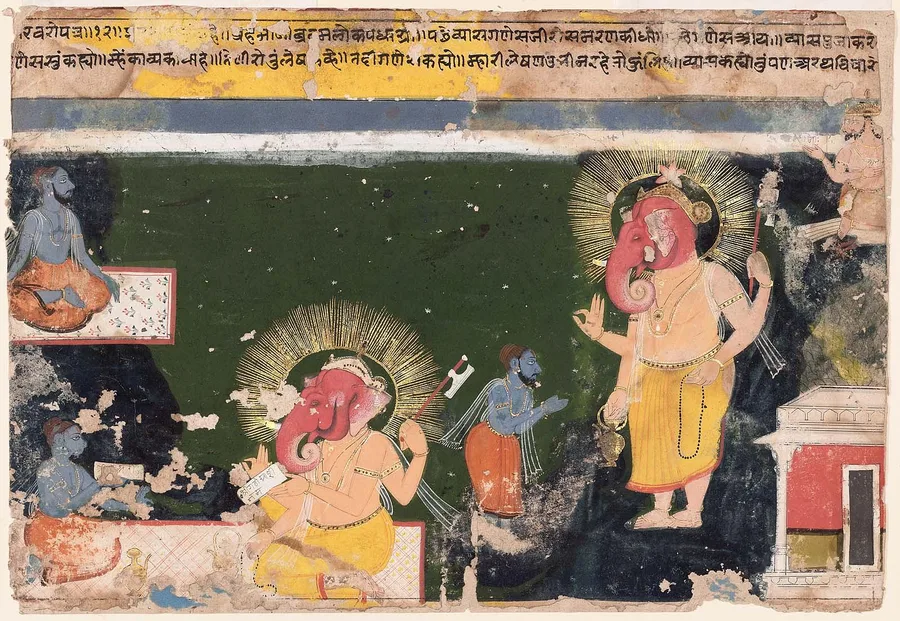 Painting: 17th-c. Mewar manuscript, Museum of Fine Arts, Boston / Wikimedia Commons (Public domain)
Among the most celebrated stories connecting Shree Ganesh to the world of knowledge is his role as scribe for the sage Vyasa during the composition of the Mahabharata, the great epic that remains central to devotional and philosophical literature to this day.
A Condition for an Impossible Task
As the story is told, Vyasa, seeking to dictate the entire epic without pause so that his thoughts would not be lost, needed a scribe capable of writing continuously and with total understanding. He approached Shree Ganesh, who agreed on one condition: that Vyasa recite without ever stopping, for Ganesha's pen, once started, would not lift from the page.
The Broken Tusk, Given in Service
Vyasa accepted, with a condition of his own — that Ganesha understand every verse before writing it down, giving the sage brief moments to compose difficult passages in his mind. Partway through this immense undertaking, tradition holds, Shree Ganesh's writing implement broke, and rather than pause the sacred work, he snapped off his own tusk and continued writing with it — the same broken tusk that remains part of his iconography to this day.
What Devotees Seek
Students, writers, and anyone engaged in demanding intellectual work invoke this story of Shree Ganesh's total, uninterrupted commitment, asking for the same focus that carried the Mahabharata from Vyasa's mind to the page without a single pause.