 Sankashti Chaturthi Mandal
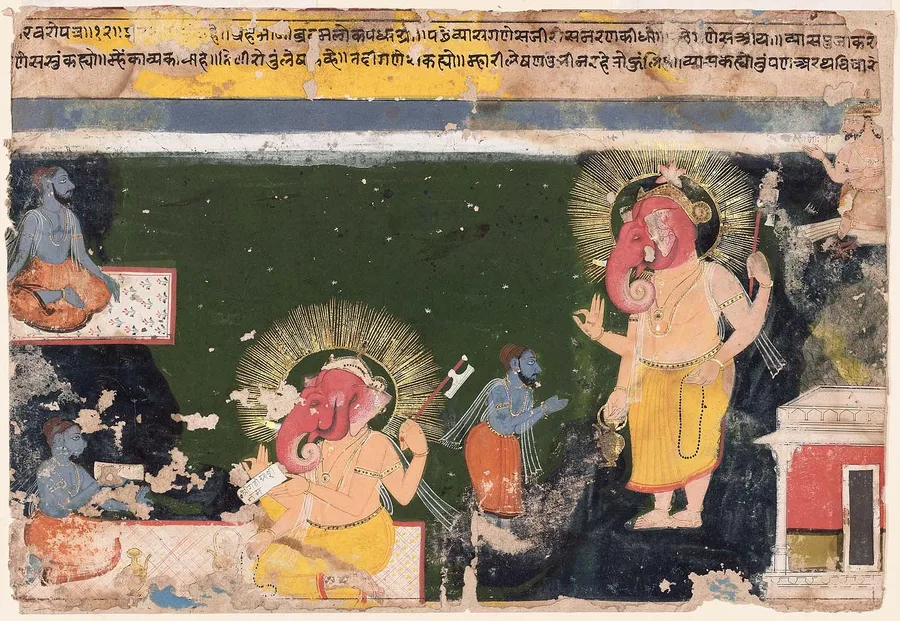 Painting: 17th-c. Mewar manuscript, Museum of Fine Arts, Boston / Wikimedia Commons (Public domain)
When Shree Ganesh's writing implement broke partway through the Mahabharata's composition, his response — breaking off his own tusk to continue without pause — became the origin of his most recognizable feature and a lasting symbol of knowledge's priority over personal cost.
A Choice Made Without Hesitation
Rather than pause the sacred work to seek a replacement pen, Shree Ganesh chose immediately to sacrifice part of his own body, ensuring that the flow of Vyasa's recitation, and the knowledge it carried, would not be interrupted for even a moment.
A Symbol Carried Ever After
This broken tusk, now permanently part of how devotees picture Shree Ganesh, transforms what could have been read as loss or disfigurement into a mark of highest honor — visible proof of a sacrifice made willingly in service of something greater than himself.
What Devotees Seek
Devotees drawn to this story take from it a lasting principle: that the pursuit and transmission of genuine knowledge is worth real personal sacrifice, a lesson Shree Ganesh's own broken tusk continues to teach to this day.