 Sankashti Chaturthi Mandal
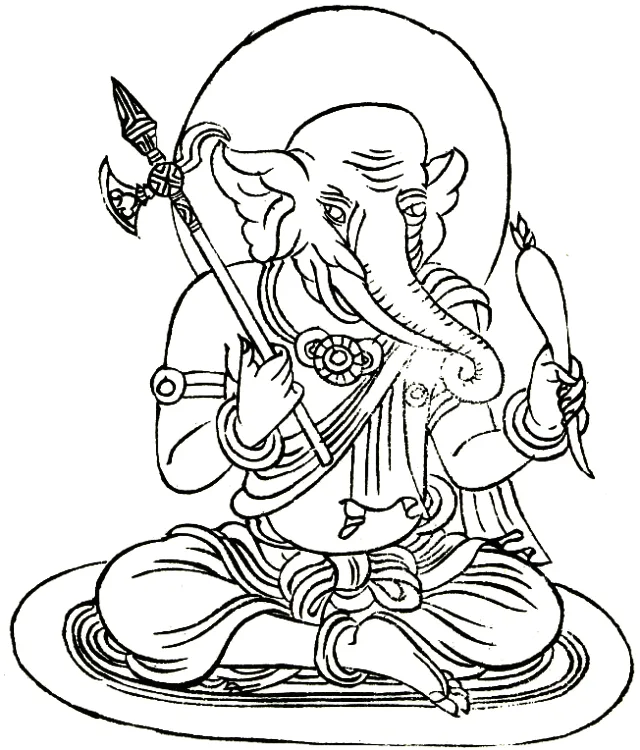 Photo: Unknown author / Wikimedia Commons (Public domain)
Far beyond India's borders, the presence of Shree Ganesh traveled along the same routes that carried Buddhism from India through Central Asia and China into Japan, taking on a new name and form as Kangiten.
A Journey Through Centuries
Kangiten's worship in Japan began around the eighth and ninth centuries CE, introduced through Shingon Buddhism, the esoteric tradition founded by the monk Kukai, who studied in China and brought this and other teachings back to Japan.
A New Iconographic Form
While sometimes depicted as a single elephant-headed figure much like Ganesha, Kangiten became especially known in Japan through the Sōshin, or Dual, form — two elephant-headed figures embracing, understood to represent the transcendence of duality and the harmonious balance of opposites, themes not unlike those carried by Shree Ganesh's own broken tusk in Indian tradition.
What This Journey Reveals
Kangiten's centuries-long presence in Japanese Buddhism stands as a striking testament to how far Shree Ganesh's influence has traveled, and how differently his essential qualities — the resolving of obstacles, the balance of opposing forces — have been received and reimagined in a distant land.