 Sankashti Chaturthi Mandal
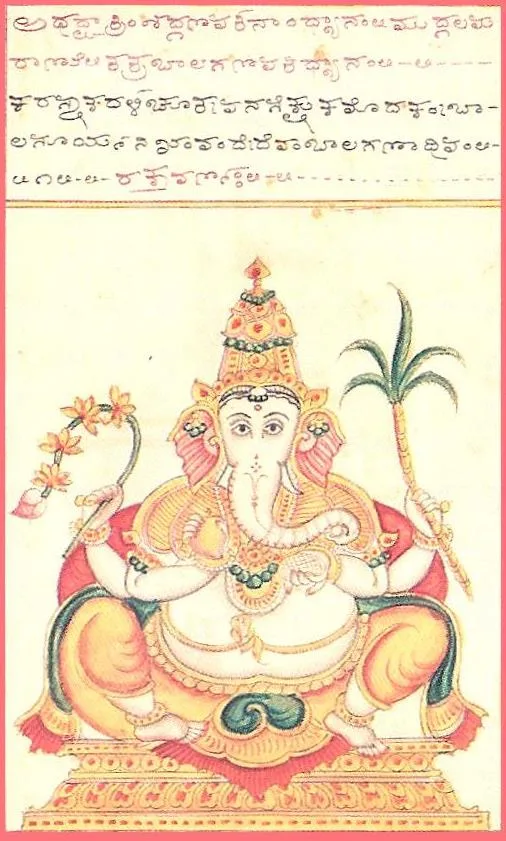 Painting: Folio from the Sritattvanidhi manuscript, Mysore, 19th century / Wikimedia Commons (Public domain)
Of the thirty-two classical forms of Ganapati described in the Mudgala Purana, Bala Ganapati is the first — the childlike form, red in hue, through which Shree Ganesh is envisioned as an infant held in the tenderness of his mother's care.
Appearance
Bala Ganapati is shown with four arms, each hand holding a fruit of the earth: a banana, a mango, a bunch of jackfruit, and a stalk of sugarcane. His trunk curls toward a modak, his favored sweet, cradled close as an infant might hold a treat offered by a loving parent.
What the Fruits Represent
The four fruits are traditionally read as the gifts of the earth itself, presented to the child Shree Ganesh as a mother presents nourishment to her own — abundance, sweetness, and sustenance freely given without condition. In this form, Shree Ganesh is closely associated with the earth, embodying the innocence and boundless potential present at the very beginning of life.
What Devotees Seek
Devotees turn to Bala Ganapati when seeking blessings for children, for new beginnings, and for the innocent, unclouded faith that a child brings to devotion. He is a reminder that the path to the divine need not be complicated — a pure and simple heart, offered freely, is enough.