 Sankashti Chaturthi Mandal
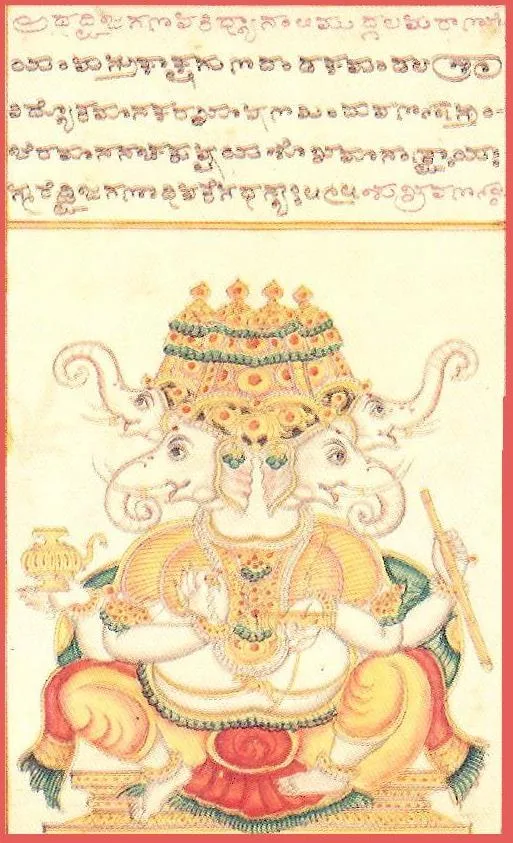 Painting: Folio from the Sritattvanidhi manuscript, Mysore, 19th century / Wikimedia Commons (Public domain)
Dvija means "twice-born," and Dvija Ganapati, white and four-headed, is the form of Shree Ganesh associated with the sacred beginning of formal learning — the point at which a student's second birth, a birth into knowledge, begins.
Appearance
Dvija Ganapati is shown with four heads and four arms, holding a rosary, a water pot, a walking-stick, and a palm-leaf manuscript — the traditional implements of a student and teacher of sacred knowledge. His four heads have led this form to be likened to Lord Brahma, the creator, himself.
What the Form Represents
In tradition, "twice-born" refers to the sacred thread ceremony through which a student is formally initiated into disciplined learning — a second birth, into knowledge and discipline, following the first birth into life. Dvija Ganapati embodies this beginning, and the manuscript in his hand is a reminder that learning is not a single event but a lifelong devotion.
What Devotees Seek
Students beginning their education, teachers guiding others, and anyone undertaking serious study turn to Dvija Ganapati for the discipline, clarity, and perseverance that true learning demands.